How Long Does Planning Permission Take? Borough Guide 2026
Typical Planning Timelines for Householder Applications
The statutory target is 8 weeks from validation for most householder applications. In practice, most London homeowners should budget 10 to 14 weeks from the date they submit, once you factor in validation checks, consultation periods, and officer queries.

Key Insights at a Glance
- The 8-week target runs from validation, not submission. An incomplete application can sit in the queue for weeks before the clock starts.
- Most straightforward householder applications in London take 10 to 14 weeks end to end.
- Applications in conservation areas or affecting listed buildings routinely take 16 to 20+ weeks due to specialist consultee involvement.
- London Borough performance varies significantly. Boroughs like Richmond upon Thames, Kingston upon Thames, and Bromley tend to decide faster. Westminster, Kensington & Chelsea, and Camden are consistently slower due to high heritage designation levels and workload.
- Missing documents at submission is the single biggest cause of delay. Validation failures can cost you 2 to 4 weeks before the clock even starts.
- Planning permission, once granted, is valid for 3 years from the date of the decision notice.
- Pre-application advice, while not mandatory, often shortens the overall timeline for complex or sensitive sites.

Typical Planning Timelines for Householder Applications
For a standard householder application (a single-storey rear extension, side return, or modest dormer), the council has a statutory 8-week target to issue a decision. This is measured from the date of validation, not the date you submit.
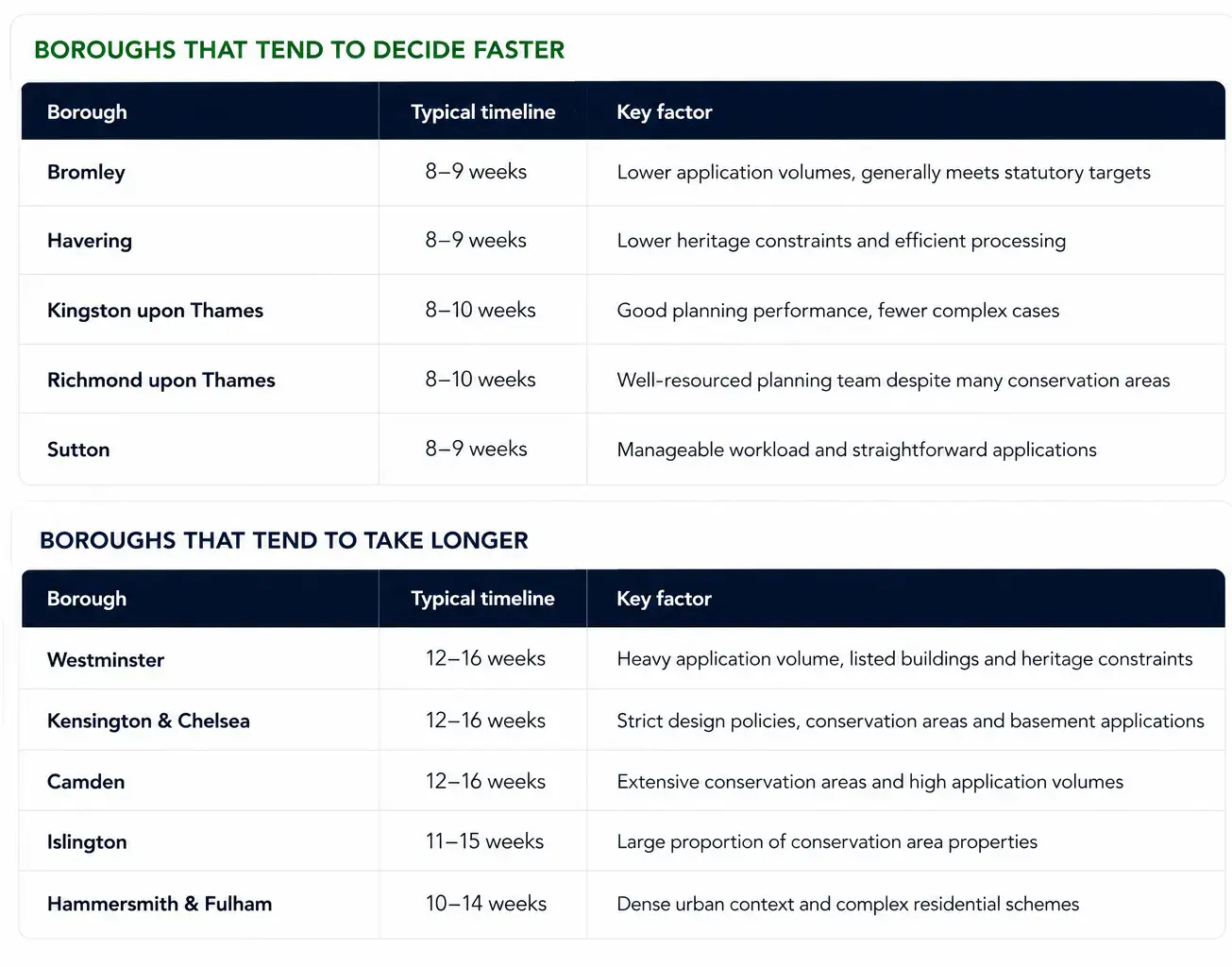
Here is a realistic week-by-week breakdown:
Week 1 to 2 — Submission and validation The council checks your application: correct fee, complete drawings, right certificates, and all supporting documents. If anything is missing, they issue a validation request and the clock does not start until you respond.
Week 2 to 5 — Consultation period Neighbours are notified. Statutory consultees (highways, ecology, heritage, etc.) are given 21 days to comment.
Week 5 to 7 — Officer assessment The case officer reviews the proposal against the development plan, NPPF, and local SPDs. They may request further information or minor amendments.
Week 7 to 8 — Decision Delegated decisions (the vast majority of householder applications) are made by a senior planning officer under delegated powers. Committee referral is rare for extensions, but does happen in sensitive locations.
In a best-case scenario, with a clean, complete submission, you can receive a decision in 8 to 9 weeks. Realistically, allow 10 to 14 weeks from submission for most London applications.
Which London Boroughs Are the Fastest and Slowest
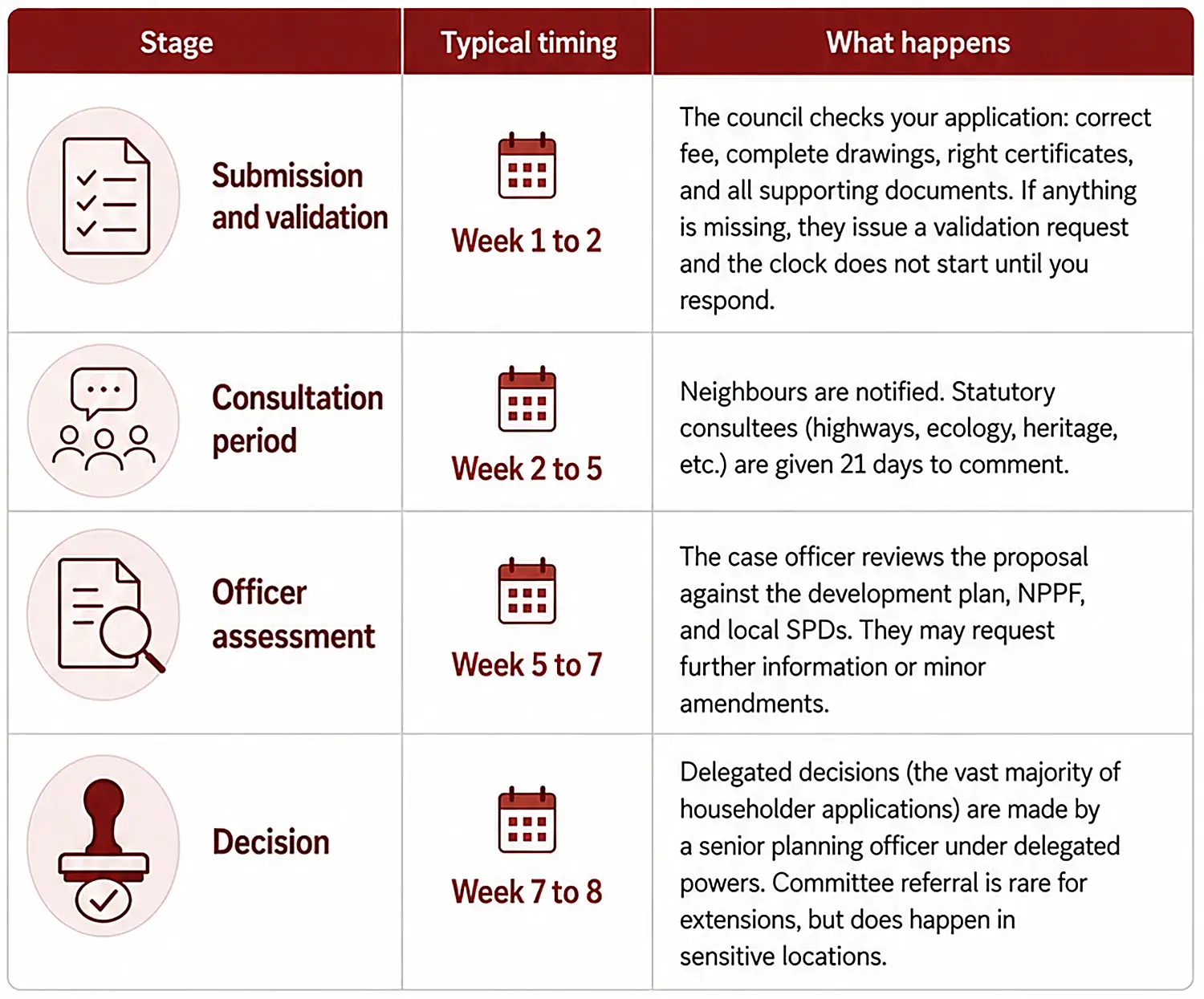
Performance varies considerably across the 32 London boroughs. Planning authority resourcing, caseload volume, and the proportion of heritage-designated sites all affect speed.
Boroughs that tend to decide faster:
- Bromley
- Havering
- Kingston upon Thames
- Richmond upon Thames
- Sutton
These outer London boroughs generally have lower volumes of complex heritage cases and reasonably resourced planning teams.
Boroughs that tend to take longer:
- Westminster
- Kensington & Chelsea
- Camden
- Islington
- Hammersmith & Fulham
In these inner London boroughs, a high proportion of properties sit within conservation areas or fall under Article 4 Directions. That triggers additional design scrutiny, specialist consultee involvement, and in some cases committee referral. It is not unusual for applications in these areas to take 16 to 20 weeks.
A practical note: Borough league tables fluctuate year on year. Staff turnover, caseload backlogs, and government monitoring of performance all influence how quickly individual boroughs process applications. Always check the council’s current performance data on Planning Portal or their own website before setting your project programme.
Why Some Planning Applications Get Delayed
Understanding the causes of delay helps you plan around them.
The most common reasons for delay:
- Validation failure. Missing drawings, incorrect application form, wrong fee, or absent certificates. This pauses the clock entirely.
- Objections from neighbours. High volumes of objection can prompt the case officer to consult more widely, extend the comment period, or escalate to committee.
- Specialist consultee involvement. Conservation officers, highways, ecology, flood risk, and archaeology can each add weeks if their input is required.
- Incomplete or unclear drawings. Ambiguous plans result in “request for further information” notices. Each round of queries can add 2 to 4 weeks.
- Officer workload. In under-resourced teams, even straightforward applications can sit unallocated for several weeks.
- Committee referral. If an application is contentious or exceeds delegated limits, it goes to planning committee. Committee meetings are typically monthly, which can add 4 to 6 weeks.
How Validation Issues Affect Approval Times
Validation is the stage most homeowners overlook. It is also the single biggest controllable cause of delay.
When you submit an application, the council’s validation team checks it against a local requirements list. Every council publishes this list, but many applicants submit without reading it.
Common validation failures include:
- Incorrect or missing certificates of ownership
- Drawings at the wrong scale or missing required information (levels, materials, dimensions)
- Absent Design and Access Statement or Heritage Statement where required
- Wrong fee calculation
- Missing flood risk assessment in Zone 2 or 3
If your application fails validation, you receive an invalidation notice. You must resubmit the missing items. Only then does the 8-week clock start. That process alone can cost you 2 to 4 weeks.
The fix is straightforward: check the council’s local validation requirements before you submit and ensure every document is complete, clearly labelled, and at the right scale.
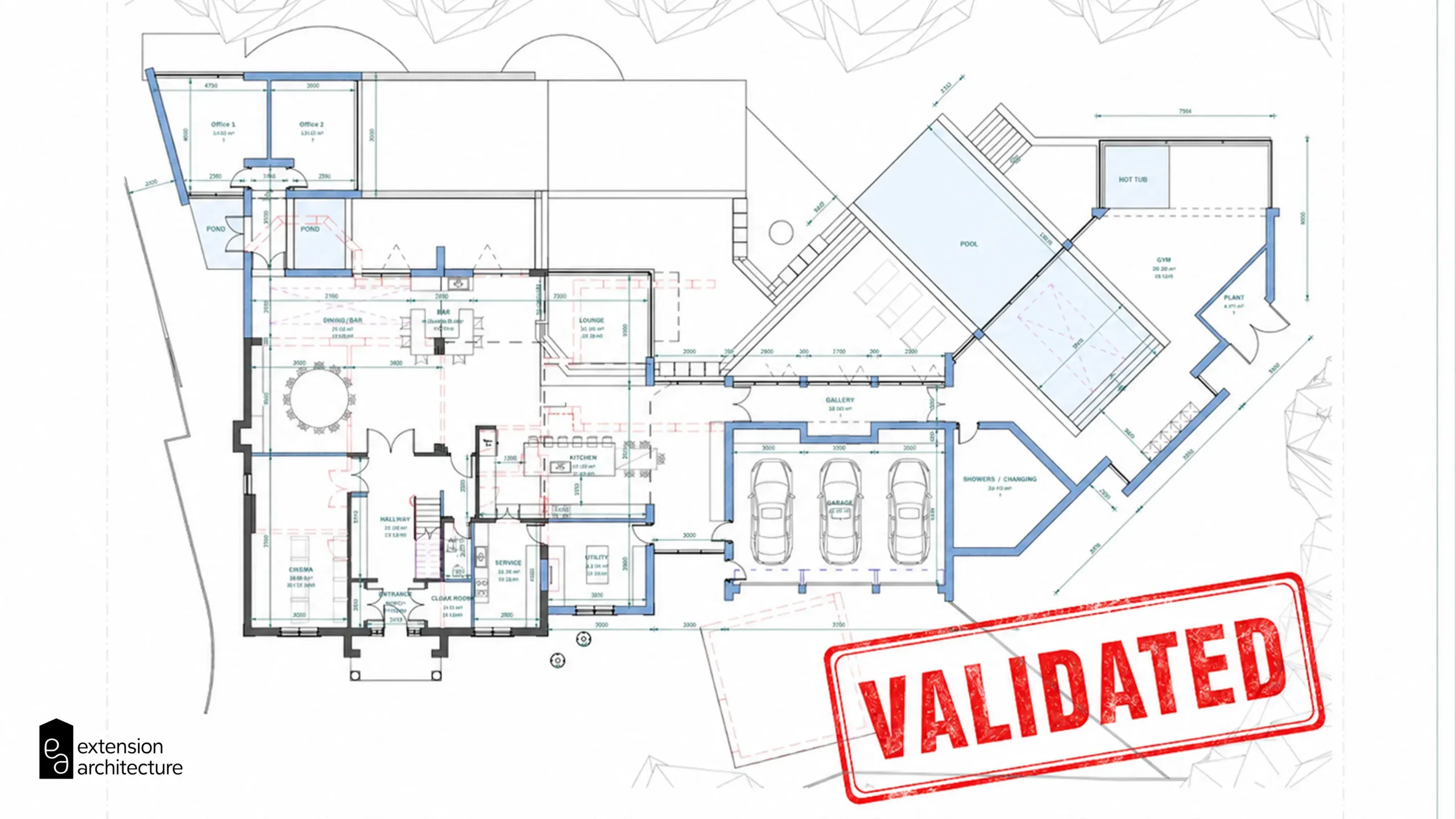
What Happens During the Consultation Period
Once validated, the council opens a statutory consultation period. This runs for 21 days and involves:
- Neighbour notification letters sent to adjoining and nearby properties
- Site notice posted at or near the application site (required in some cases)
- Statutory consultee notification (highways, Thames Water, the Environment Agency, Historic England, and others depending on the proposal)
Any representations made during this period are placed on the public register. The case officer must consider them in the assessment.
Consultation does not stop the clock. However, if significant objections are received, the case officer may extend the period informally or seek further information from the applicant.
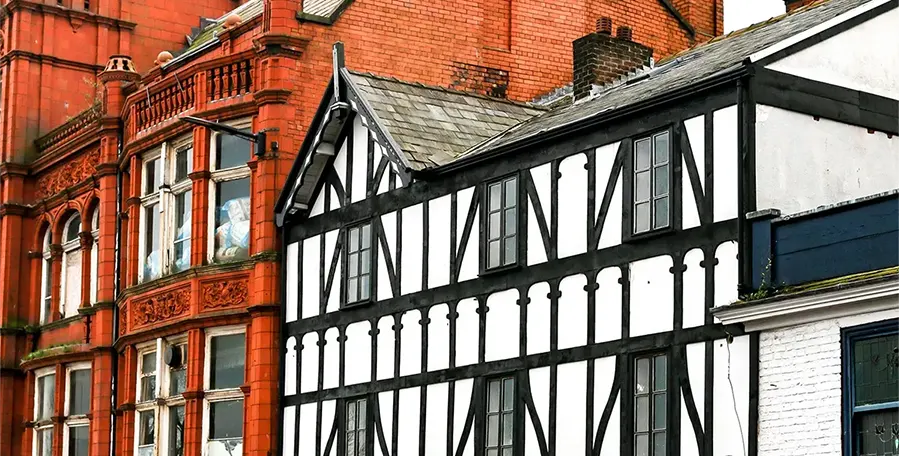
In conservation areas: Historic England and the council’s own conservation officer will typically be consulted. Their input carries significant weight and can reshape the recommendation, even on minor works.
Ways to Speed Up Your Planning Application
There are concrete steps you can take to reduce the overall timeline.
Before submission:
- Use pre-application advice (pre-app) for anything in a conservation area, near a listed building, or on a constrained site. It costs money but can prevent a refusal.
- Check the local validation requirements list carefully. Every council publishes one.
- Prepare all documents before submitting — drawings, forms, fee, certificates, and any supporting statements.
At submission:
- Submit a complete, accurate application. Every missing item is a potential delay.
- Include a well-written planning statement. It gives the case officer the context and policy justification they need to approve at officer level.
After submission:
- Respond quickly to any officer queries. A slow response from an applicant is a common and entirely avoidable cause of overrun.
- Monitor the application on the council’s public register and check for any requests for information.
Do Extensions and Loft Conversions Take Different Amounts of Time
In most cases, no. Both are householder applications subject to the same 8-week statutory target.
However, certain types of loft conversion do take longer:
- Mansard roofs in conservation areas often require a Heritage Statement and conservation officer input, which adds time.
- Hip-to-gable conversions on corner plots may trigger neighbour concern and closer design scrutiny.
- Large rear extensions requiring Neighbour Consultation Scheme (Prior Approval) under Permitted Development are subject to a 42-day target rather than 8 weeks.
If your extension or loft conversion is straightforward and not in a sensitive location, you should expect the same 8 to 14 week timeline regardless of project type.
For works that fall within Permitted Development rights, no planning application is needed. However, you may still need Prior Approval (for larger extensions) or a Lawful Development Certificate (LDC) for peace of mind, which typically takes 8 weeks.
What to Expect After Planning Approval Is Granted
Receiving a decision notice is not the end of the process. There are several steps between approval and being able to start work.
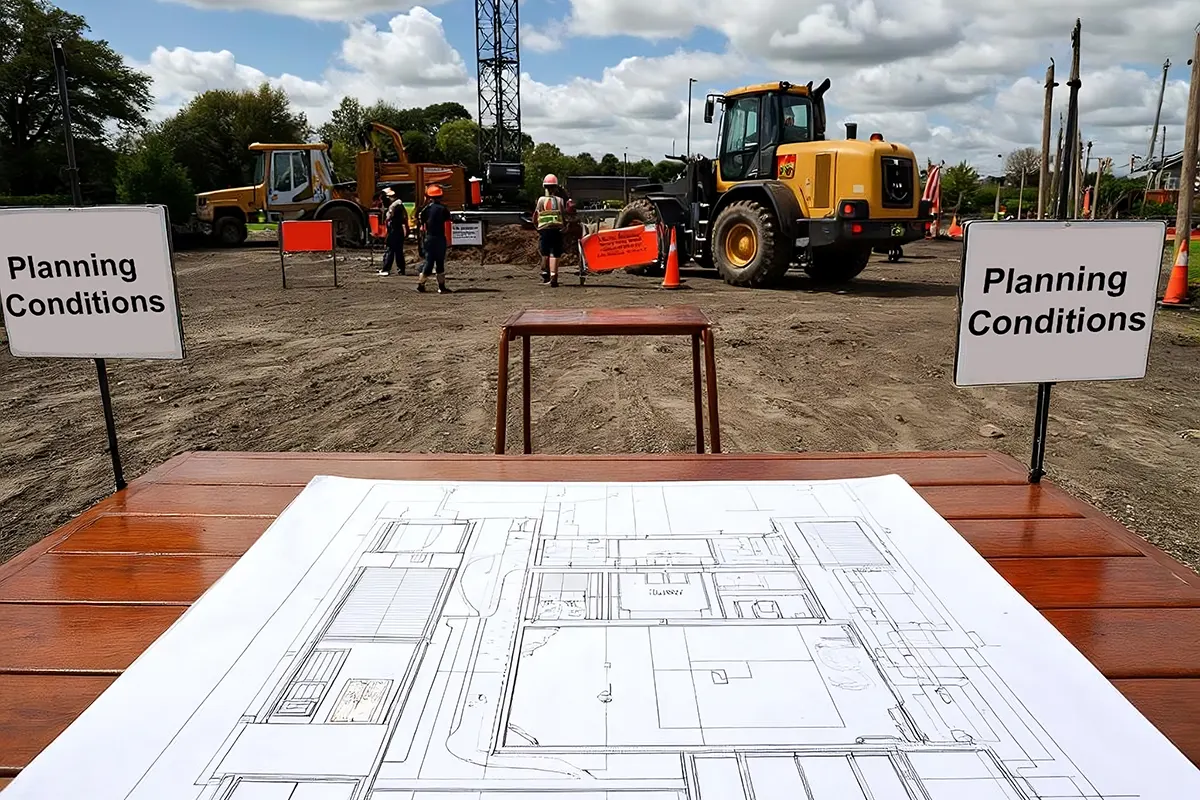
Conditions Almost every grant of planning permission includes conditions. These must be read carefully. Some conditions must be discharged before work starts (pre-commencement conditions). Submitting a discharge of conditions application to the council takes a further 8 weeks as a general guide.
Validity period Planning permission is valid for 3 years from the date of the decision notice (unless the permission states otherwise). You must begin development within this period. Beginning means a material start on site, not just ordering materials or clearing vegetation.
Building Regulations Planning permission and Building Regulations approval are separate. You will need Building Regs sign-off before construction begins. This runs in parallel but is a different process with different fees and inspections.
Party Wall matters If your extension or loft conversion affects a shared wall, you must serve Party Wall notices on adjoining owners before work starts. This process can take 2 to 12 months depending on neighbour cooperation.
What success looks like: A clean decision notice with manageable conditions, no pre-commencement conditions that are difficult to discharge, and no third-party legal challenges. Your architect or planning consultant should review the decision notice before you instruct a builder.
Frequently Asked Questions About How Long Does Planning Permission Take: Borough Guide 2026
How long does planning permission take in London? For a standard householder application such as a rear extension or loft conversion, the statutory target is 8 weeks from the date of validation. In London, most applications take 10 to 14 weeks from submission to decision. In heritage-sensitive boroughs such as Westminster or Camden, 16 to 20 weeks is common.
Does the 8-week clock start when I submit my application? No. The clock starts from the date of validation, not submission. If your application is missing documents, the council will invalidate it and the clock will not start until you resubmit the correct information. This can add 2 to 4 weeks.
Which London boroughs are the slowest for planning permission? Westminster, Kensington & Chelsea, and Camden are consistently among the slowest. This reflects their high volume of conservation area and listed building cases, which require more specialist assessment. Outer London boroughs such as Bromley, Havering, and Richmond tend to process applications faster.
How long does planning permission last once granted? Planning permission is valid for 3 years from the date of the decision notice. You must make a material start on site within that period. If you fail to start in time, you will need to reapply.
Can I speed up my planning application? Yes. The most effective steps are: submit a complete and accurate application from day one, use pre-application advice for complex sites, provide clear drawings and a well-drafted planning statement, and respond quickly to any officer queries.
What happens if my planning application is refused? You can appeal to the Planning Inspectorate within 12 weeks of the refusal decision. Written representation appeals typically take 18 to 24 weeks to determine. Alternatively, you can revise and resubmit the application, addressing the reasons for refusal. Extension Architecture can advise on the strongest route forward.